












On Wednesday, May 6, 2026, Saudi Arabia and Kuwait declared a major shift in their policy towards the conflict with Iran, ending restrictions that previously prevented the U.S. from using their airspace and military bases. This shift in policy will allow the U.S. to resume Operation Project Freedom, the U.S. military operation aimed at escorting commercial vessels through the Strait of Hormuz.
The End of Gulf Hedging
Saudi Arabia and Kuwait reopening their bases to the United States signals that the Gulf monarchies increasingly view Iran as a long-term strategic threat, rather than a regional partner to accommodate. Even if Iran is able to hold onto military leverage in the Strait of Hormuz, its broader political position in the region has weakened substantially in the wake of its indiscriminate attacks against Gulf monarchies and their infrastructure.
The decision made by Saudi Arabia and Kuwait may appear to be tactical and economic on the surface, however, the move represents a much larger shift: an ideological change in Gulf strategic thinking. After years of a precarious détente with Tehran, the Gulf monarchies have seemingly switched their attitude from Iran being a difficult and concerning neighbor, to a legitimate long-term threat to trade, regional stability, and regime security.
For years, the Gulf states have tried to maintain a careful balance between their economic ties with America, avoiding war with Iran, rapid economic development and de-escalating regional conflicts. However, Iran’s attitude and actions since the onset of Operation Epic Fury have cornered the Gulf states to the point that they felt forced to move back closer to Washington. Specifically, the reversal in policy shows that the initial hesitancy from the Gulf monarchies was outweighed by the underlying threat from Tehran.
The shift in policy represents a broader change in political attitude: Gulf states are no longer convinced that neutrality with, or accommodation for, Iran is sustainable. This shows that the Gulf has moved decisively from cautious balancing, back toward hard alignment with the United States security infrastructure.
The decision by Saudi Arabia and Kuwait to restore military access to the United States does not mean that Iran has lost all of its power in the region. Tehran still possesses missiles, drones, and proxy networks that continue to pose serious regional threats.
Iran’s Weakening Political Position
Tehran’s most potent weapon is its apparent chokehold on the Strait of Hormuz, which has sent the global economy into a frenzy. However, even though Iran has posed a major threat to the global flow of oil, Iran’s ability to pressure the Gulf states into neutrality seems to have become obsolete.
For years, Saudi Arabia and other Gulf monarchies have engaged in a careful and calculated détente with Iran, attempting to hedge confrontation and accommodation, with major fears of a potential escalation. The clearest example of the Gulf—Iran détente occurred in 2023, when Saudi Arabia and Iran restored economic relations in a Beijing-brokered deal, after seven years of severed ties. That agreement was a clear example of Saudi Arabia seeking accommodation with Iran, while also keeping them in check.
The context of recent political hedging between the Gulf and Iran makes the recent reversal of policy even more significant. The initial restrictions imposed by Gulf states on the U.S. Operations Epic Fury and Project Freedom were marked by a fear about potential Iranian targeting or retaliation. But, after further diplomatic pressure from the Trump administration, along with regional escalations by Iran against Gulf states, Saudi Arabia and Kuwait decided to lift their airspace and base restrictions, allowing the restoration of U.S. military access.
This development indicates that Iran’s political plan may have backfired, as the initial attacks on Gulf states and Saudi Arabia were intended to force these nations to distance themselves from the U.S. However, Iran’s pressure campaign around the Strait of Hormuz has actually made the Gulf more dependent on the U.S., not less. Iran may maintain the ability to disrupt the trade through the Strait, but it has lost the ability to project its political influence on the region.
Iran has also suffered setbacks via the military defeats of their proxy network, or what they would call the “Axis of Resistance.” Analysts at Harvard University’s Belfer Center have described an apparent degradation of Iran’s proxy model, noting that Hezbollah’s massive military defeat in the summer/fall of 2024, coupled with the fall of Bashar-Al-Assad’s murderous regime in December, severely weakened Iran’s ability to dominate Lebanon and Syria through their allied forces. The fall of Assad’s regime was especially damaging to the Iranian regime, as Syria had long stood as a crucial logistical position for Iranian interests.
The defeats of these proxies has been detrimental for Iran, because its regional power has historically relied on much more than direct military strength. Since Iranian allies in Syria, Lebanon, and Gaza have been either severely weakened, or destroyed altogether, Iran’s scope of power has become much narrower. Historically relying more on proxy warfare and diplomacy, Iran has had to shift towards more conventional military measures, including direct intervention in the Gulf. Tehran may still have the power to launch missiles and disrupt shipping lanes, but that is widely different from commanding political loyalty in states across the region.
Iran still has militaristic leverage, but it has lost political authority. The more Iran continues to rely on the threats surrounding the Strait of Hormuz, the more it proves to its regional neighbors that it cannot be viewed as a trustworthy regional actor. This development has created a complex dilemma where Iran can still frighten the Gulf, but it can no longer persuade it.
The Return of An American-Centered Gulf Order
The reopening of the Gulf bases to the U.S. in Saudi Arabia and Kuwait point to the notion that the Middle East is shifting away from the post-COVID “Gulf hedging,” and back towards a U.S.-centered regional security system.
For several years, the Gulf states have been carefully balancing U.S. relations, avoiding a conflict with Iran, expanding Chinese economic ties and pursuing rapid modernization; this recent conflict showed that the Gulf still is dependent upon American military power and strength. Beijing may be able to broker agreements, but Washington is the one that provides tangible security.
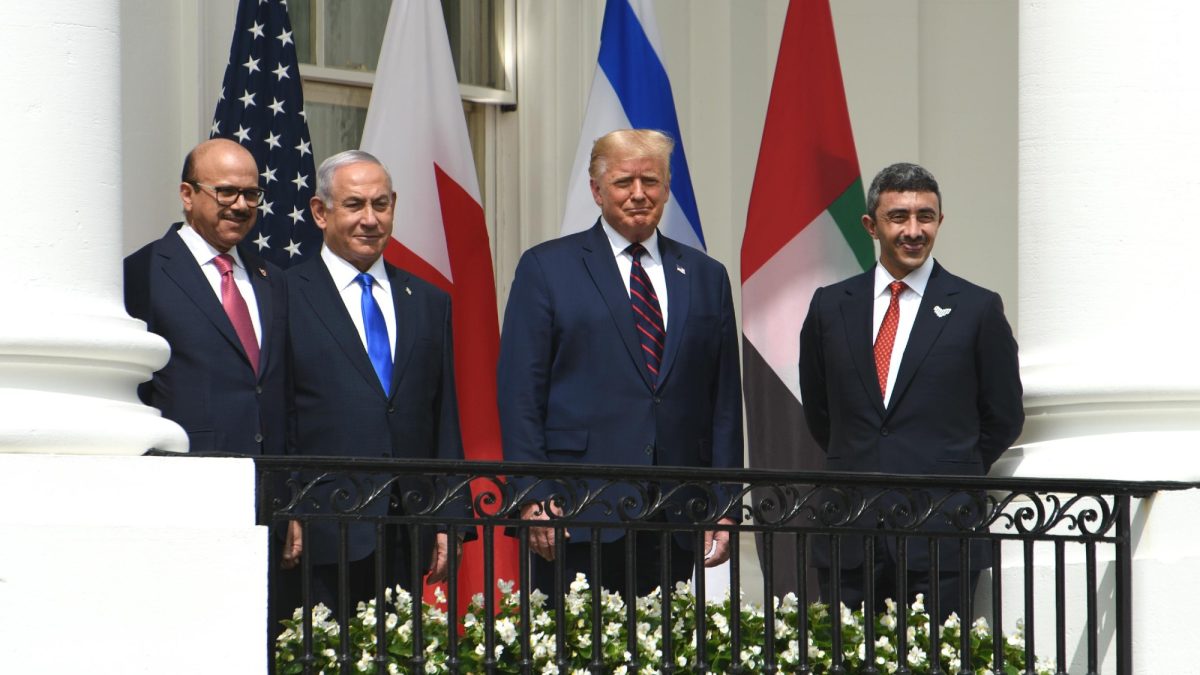
When Iran attacked the United Arab Emirates, in an unprecedented move, Israel supplied Iron Dome technology to the UAE, as well as the technicians trained to operate it. This marks the first time that Israel has militarily defended an Arab nation, showing that the Abraham Accords have been brought into action, not merely symbolic agreements on paper. The Times of Israel marked that it was the first time Israel had sent Iron Dome technology to any country outside of Israel and the United States.
For Saudi-Israeli normalization, the effect of this action is complicated, but potentially monumental. In the public sphere, the Saudi monarchy has to be careful because Israel remains extremely controversial and disliked in the Arab and Muslim world, especially because of the ongoing conflicts in Gaza and Lebanon. However, strategically speaking, Israel defending the UAE enhances the central argument behind Saudi-Israeli normalization: Israel can be a useful and reliable security partner against Iran. That action could persuade Saudi Crown Prince Mohammed Bin Salman to seriously consider normalization with Israel in the long-term, especially if U.S. guarantees are attached, and they are able to receive some concessions for Palestinians in Gaza and the West Bank. Israel’s upcoming elections this year will be crucial for a potential path to normalized relations.
For the UAE, this action likely deepens the alliance with Israel dramatically. States rarely forget who defends them when they are being bombarded with missile and drone attacks. The UAE may still continue to publicly call for de-escalation, but behind closed doors, this greatly strengthens the Israel-UAE partnership. Reuters reported that the UAE defended its partnership as a “sovereign matter,” showing that Abu Dhabi is not willing to back away from their defense ties.
The long-term implications of this shift could be substantial. Iran may continue to possess significant military leverage through missiles, drones, and its geographical position along the Strait, but the broader regional order has consolidated against Tehran, rather than accommodating it.
Any questions, comments, or concerns, reach out to [email protected]