


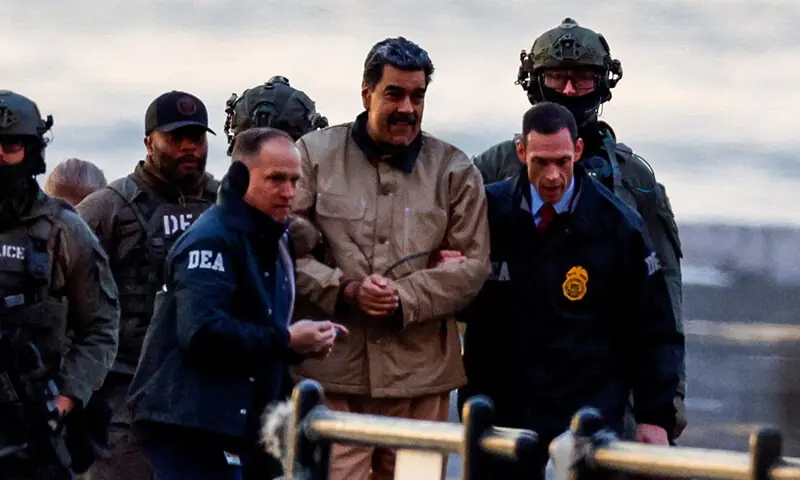

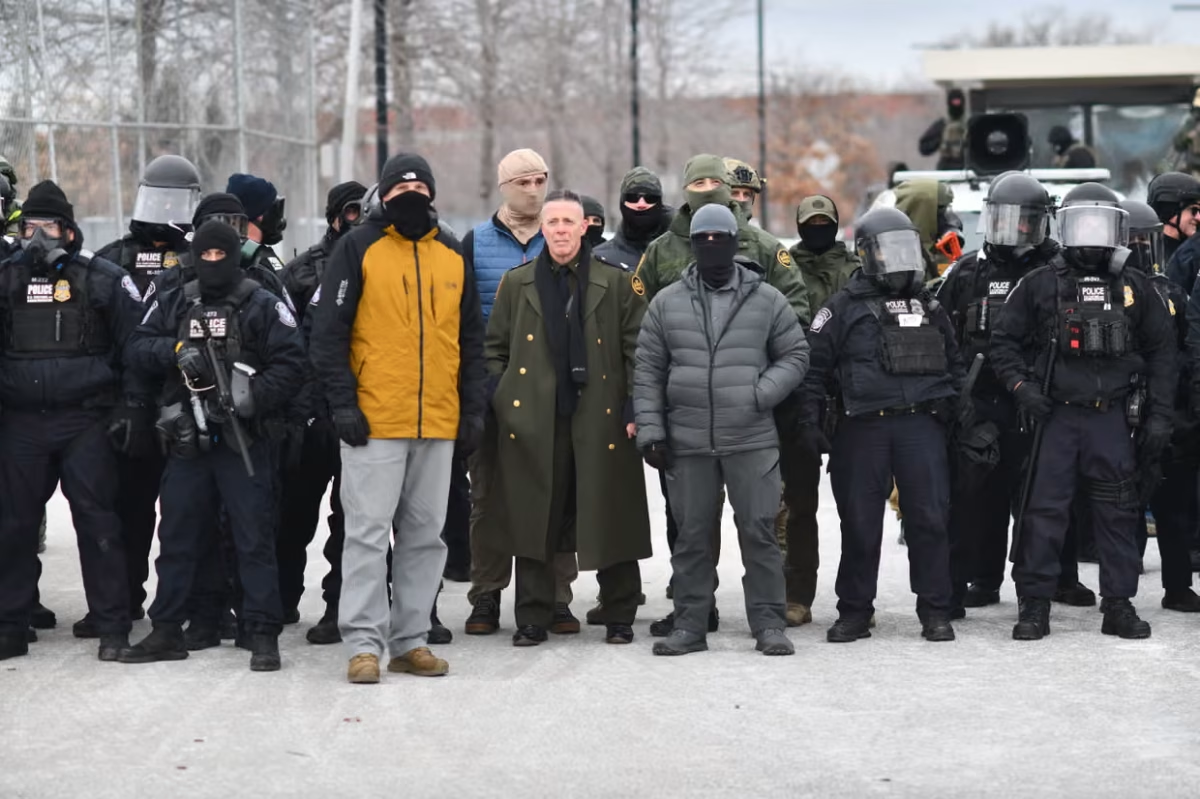







On Jan 3, 2026, the United States government launched a military operation, codenamed Operation Absolute Resolve, carried out by the U.S Delta Force, to capture Venezuelan President and accused narco-terrorist Nicolás Maduro and his wife Cilla Flores. The U.S Delta Force extracted Maduro from Caracas, Venezuela to New York City where he was arraigned in federal court on charges including narco-terrorism and crimes against humanity. Maduro denies the charges against him, arguing that the United States has kidnapped the rightful President of Venezuela.
Maduro and Flores were indicted by the U.S Department of Justice in March 2020 in the Southern District of New York. Originally, the reward for his capture was $15 million dollars, but by Maduro’s capture the reward had gone up to $50 million dollars. Successive U.S administrations under Presidents Trump, Biden, and the current administration maintained efforts to pursue Maduro, though the operation to apprehend him did not take place until 2026. However, not everyone in the United States and the world agrees that the proceedings are just, as the event has sparked international debate over sovereignty and international law.
Global reactions to Maduro’s capture have been mixed. Governments including Russia, China, Iran and Cuba criticized the operation as a violation of Venezuelan sovereignty. Contrastingly, The E.U, United States, and many U.S-allied countries cited Maduro’s history of election fraud and corruption. Analysts say the operation could mark a major turning point in Venezuelan politics, with broader regional and geopolitical implications as well.
Venezuela’s economy has struggled for many years with poverty and hyperinflation. Although the citizenry is one of the poorest in the world, the government controls the largest oil reserves out of any country in the world with trillions of dollars in reserves. Hugo Chávez, leader of the Bolivarian revolution, and Nicolás Maduro’s mismanagement of government resources have plummeted Venezuela’s economy. Additionally, Venezuela’s abrasive politics from these socialist regimes have led to major U.S sanctions on the Venezuelan economy.
Critics of foreign intervention argue that military actions often can lead to long-term economic and political consequences for countries, rather than improve the situation. However, for many Venezuelans around the world, Jan 3, 2026 was a joyful day for them, celebrating around the world.
While there was definitely an element of risk for the U.S to enter Venezuela, U.S officials argued that enforcing the arrest warrant was more pressing than the risks of an intervention. Despite the major risks in Venezuela, the United States suffered zero casualties during the operation.
The capture of Nicolás Maduro is not a small-scale political event. It has major economic and political importance. It raises key questions about international law and foreign intervention. For Venezuela, the next few months will be crucial in deciding if the country finds stability or falls apart. As of now, the Vice President Delcy Rodrígues has assumed control over the government, however, she has even less democratic standing than Maduro in Venezuela and is not seen as a viable long-term solution. The Review will closely follow the unfolding events in Venezuela, and if Nobel Peace Prize winner and activist/politician María Cornia Machado will be able to make it home to Venezuela.